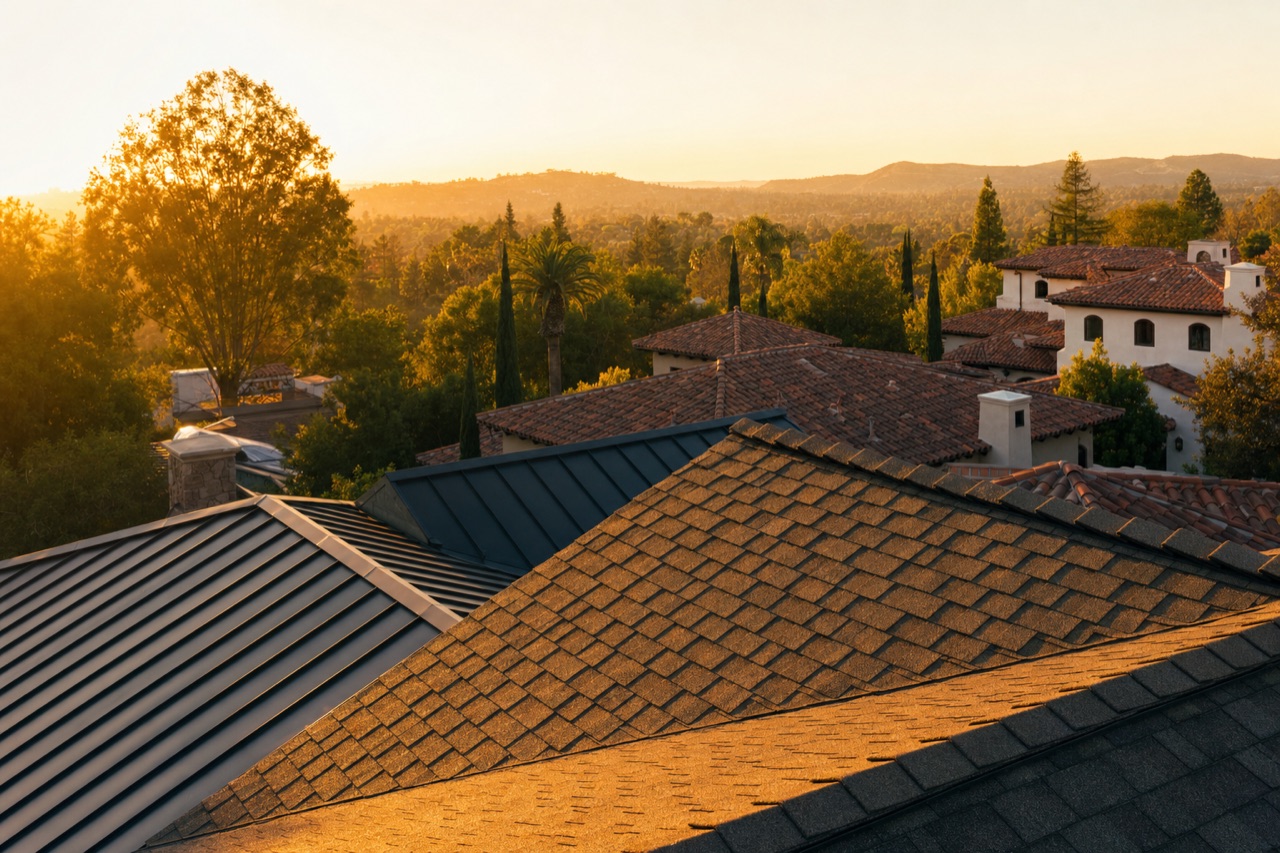
Walk into any roofing conversation and you’ll hit the same fork within minutes: asphalt, metal, or tile? Each is genuinely the right answer for some houses, climates, and budgets — and the wrong one for others. Here’s how a roofer actually thinks about the tradeoffs, including the ratings that matter and the modern synthetics most homeowners don’t know to ask about.
How to weigh any material
Before the specifics, the five questions that decide it:
- How long will you stay? A 12-year horizon and a 40-year horizon point to different roofs.
- What’s your climate? Hail, hurricane wind, wildfire, freeze-thaw, and relentless sun each reward different materials.
- Can the structure carry it? Tile and slate are heavy; many homes need an engineer’s sign-off and reinforcement.
- What does the architecture (and HOA) want? A material that sings on a Mediterranean home looks wrong on a Cape Cod.
- What’s the budget — over the life of the roof, not just day one? A roof that lasts twice as long can be cheaper per year even if it costs more upfront.
Three ratings recur across every material; learn them once:
- Fire (UL 790): Class A is the highest (most asphalt, metal, tile, and slate qualify as a system).
- Wind (ASTM D3161 / D7158): rated to a mph ceiling — but only if installed to the enhanced nailing and starter/ridge spec.
- Impact / hail (UL 2218): Class 1–4, with Class 4 the toughest. A Class 4 roof can earn a meaningful insurance premium discount in hail country.
Asphalt shingles — the default for good reasons
Asphalt covers the large majority of American homes because it balances cost, looks, ease of repair, and availability better than anything else. It comes in three tiers:
- 3-tab: flat, uniform, lightest, cheapest. 15–20 year life. Increasingly rare on new installs.
- Architectural (dimensional): laminated layers create depth and a richer shadow line. The mainstream choice. 25–30 years.
- Designer / luxury: heavier, mimics slate or shake. 30+ years.
Lifespan: 15–30 years · Cost: lowest upfront (~$350–$700/square installed) · Fire: Class A · Hail: choose a Class 4 (impact-rated) shingle in hail-prone regions.
Best for: most homes, especially if you may move within a couple of decades, and anywhere you value cheap, fast repairs. The honest downside: it’s the shortest-lived option and the most heat-sensitive — ventilation matters enormously to whether it reaches its rated age.
Metal — the long-haul investment
Metal has moved from “barns and cabins” to mainstream, and splits into two very different products:
- Standing seam: vertical panels with concealed fasteners and raised, interlocking seams. The premium, leak-resistant choice — no exposed screws to back out over time.
- Exposed-fastener (ribbed/corrugated) panels: cheaper, faster, with visible screws and rubber washers that need re-torquing every couple of decades.
- Stone-coated steel / metal shingles: stamped to look like shake or tile, with a granular finish.
Lifespan: 40–70 years · Cost: 2–4× asphalt (~$600–$2,000/square) · Fire: Class A · Wind: excellent, often rated to 140+ mph · Energy: reflective finishes cut cooling load (a “cool roof”).
Best for: forever homes, harsh-sun and high-wind climates, wildfire zones, and modern or farmhouse aesthetics. Caveats: higher upfront cost, it can dent under large hail (and some policies treat denting as cosmetic and exclude it — check your coverage), and rain noise/oil-canning are real if it’s installed cheaply.
Tile — character that lasts a lifetime
Clay and concrete tile define the look of Southwestern, Spanish, and Mediterranean homes and routinely last 50–100 years.
- Clay: holds color for life, excels in hot and coastal/salt-air climates, costliest.
- Concrete: less expensive, heavier still, slightly shorter life.
Lifespan: 50–100 years · Cost: high (~$700–$1,800/square) · Fire: Class A · Weight: the catch — tile can weigh 600–1,100+ lbs per square, two to three times asphalt, so your roof structure must be engineered to carry it (budget for reinforcement on a retrofit).
Best for: the right architecture and a hot or coastal climate, when curb appeal and longevity outrank upfront cost. Individual tiles crack underfoot and in hard freezes, so freeze-thaw climates and roofs you walk often are poorer fits.
The contenders you didn’t know to ask about
- Synthetic / composite (DaVinci, Brava, etc.): polymer shingles molded to look like slate or shake, but lightweight (no structural upgrade), often Class 4 impact and Class A fire, with 30–50 year warranties. The fastest-growing premium category — a smart way to get the slate look without the slate weight or cost.
- Natural slate: the 75–150 year aristocrat. Beautiful, fireproof, and extraordinarily heavy and expensive; a specialist install.
- Cedar shake: warm, natural, and high-maintenance — needs treatment and isn’t allowed in many wildfire-prone areas.
So which one?
Specs narrow the field, but the final call almost always comes down to how it looks on your specific house. A color and profile that’s perfect on one home falls flat on the next — brick, siding, trim, landscaping, and the angle of the sun all interact with the roof, which is the single largest surface on your exterior.
A sample chip in a parking lot tells you almost nothing about that. So once you’ve used the criteria above to land on a material tier, close the loop on the look: see your chosen material rendered on a photo of your own home before you commit to a single shingle. It’s free, it takes a minute, and it’s the difference between guessing and knowing.