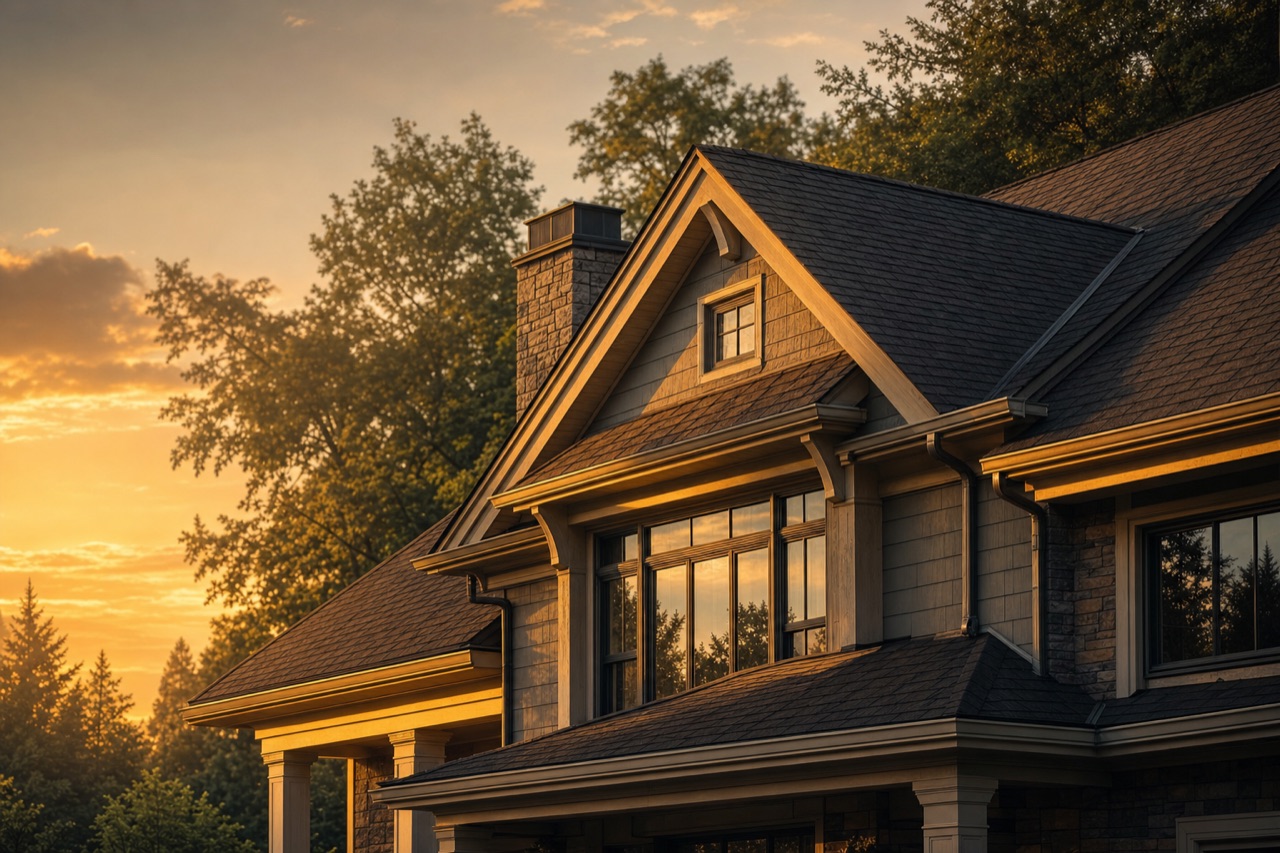
Ask ten homeowners what makes a roof last and you’ll hear about shingle brands, nail counts, and underlayment. Almost no one mentions ventilation — which is ironic, because a poorly ventilated attic is one of the most common reasons a 30-year roof taps out at 15.
The damage doesn’t come from above. It comes from the inside, and it’s slow, quiet, and almost entirely preventable.
A roof is a system that has to breathe
Your attic needs a constant, gentle current of outside air moving through it. That airflow is driven by two forces working together: the stack effect (warm air rises and exits high on the roof, pulling cooler air in low) and wind passing over the ridge. For that current to exist, you need two kinds of vents working as a pair:
- Intake vents, low on the roof — almost always in the soffits (the underside of the eaves).
- Exhaust vents, high on the roof — ideally a continuous ridge vent along the peak.
Cool air enters at the eaves, washes up the underside of the roof deck, and carries heat and moisture out the top. Break that loop — block the intake, skip the exhaust, or unbalance the two — and the system stops working.
The two enemies: heat and moisture
In summer, the enemy is heat. An unvented attic under a dark roof can hit 150°F. That heat radiates into your living space (hello, $400 July cooling bill) and, more destructively, bakes the asphalt shingles from below. Heat drives off the volatile oils that keep asphalt flexible, so the shingles age prematurely — curling, cracking, and shedding granules years ahead of schedule.
In winter, the enemy is moisture. Your household generates a startling amount of water vapor — showers, cooking, laundry, breathing. That humid air drifts up into the attic, hits the cold underside of the roof deck, and condenses. Over a winter, that means:
- Frost on the nail tips and sheathing (look for rusty nail points — a dead giveaway).
- Mold and mildew on the rafters.
- Plywood and OSB decking that delaminates and softens.
- Soggy, compressed insulation that stops insulating.
Moisture damage is the expensive one, because by the time you see a stain on the ceiling, the deck has often been rotting for seasons.
The cruel part: a brand-new premium roof installed over a starved attic will still fail early. The shingles aren’t the problem. The air is.
Ice dams are a ventilation problem
That ridge of ice at your eaves every winter isn’t bad luck. A warm attic melts the snow on the upper roof; the meltwater runs down to the cold overhang, refreezes, and builds a dam that backs water up under the shingles. Better insulation and balanced ventilation keep the whole roof deck cold and uniform, so the snow never melts unevenly in the first place.
The math: Net Free Area
Ventilation isn’t “add a couple of vents and hope.” Building codes specify how much you need, measured in Net Free Area (NFA) — the actual open area air can pass through, in square inches.
The baseline code rule (IRC R806) is 1/150: one square foot of NFA for every 150 square feet of attic floor. You can cut that in half to 1/300 if two conditions are met: the intake and exhaust are reasonably balanced (40–50% each, with at least 40% as intake high on the roof), and/or a vapor retarder is present on the warm side.
Here’s how that plays out on a typical 1,500 sq ft attic:
- At 1/150: 1,500 ÷ 150 = 10 sq ft of NFA → 10 × 144 = 1,440 square inches total.
- At 1/300: 1,500 ÷ 300 = 5 sq ft → 720 square inches total.
- Split the 720 in half: ~360 sq in of intake and ~360 sq in of exhaust.
Now turn that into hardware. Vents are rated for NFA on the package:
- A ridge vent supplies roughly 18 sq in of NFA per linear foot, so ~20 feet of ridge ≈ 360 sq in of exhaust.
- Continuous soffit venting supplies roughly 9 sq in per linear foot, so you’d want ~40 feet of soffit intake.
- A typical box (louver) vent is only ~50–60 sq in each — which is why it takes a lot of them to do what a ridge vent does cleanly.
You don’t have to run these numbers yourself, but a competent roofer should be able to show you they did.
Balance beats brute force
The single most important rule: intake should equal or exceed exhaust. People obsess over adding exhaust and forget the intake. When exhaust outpaces intake, the system gets “air-starved” and starts pulling makeup air from wherever it can — including down through other roof vents, or worse, from the conditioned house through gaps in the ceiling.
That last failure mode is why powered attic fans are often counterproductive. A big fan with inadequate soffit intake will happily suck cooled, dehumidified air straight out of your living space (raising your bills) or backdraft a water heater. Passive, balanced ventilation almost always outperforms a fan.
Know your vents
Exhaust options:
- Ridge vent (the gold standard). Continuous, invisible from the ground, vents along the entire peak where the air is hottest. Buy one with an external baffle so wind creates suction instead of driving rain in.
- Box / louver vents. Cheap and common, but spot-vent only — they leave dead zones between them.
- Gable vents. Vents in the end walls. Fine alone, but a classic source of trouble when combined with a ridge vent (see below).
- Powered / solar fans. Use with caution and only with generous intake.
Intake options:
- Continuous soffit vents — a long strip of perforated venting along the eaves. Best.
- Individual soffit vents — round or rectangular plugs.
- Drip-edge or eave (fascia) vents — for homes with little or no soffit overhang.
And don’t forget baffles (insulation chutes): foam or cardboard channels that keep attic insulation from sliding down and smothering the soffit intake. Blocked soffits are the most common hidden ventilation failure.
The cardinal sin: mixing two exhaust types
Never combine two different exhaust systems on the same attic — for example, a ridge vent and gable vents, or a ridge vent and a powered fan. Instead of working together, the higher-flow exhaust pulls air from the other exhaust opening rather than from the soffits. The result is a short circuit: air loops through the top of the roof while the lower attic — the part that actually needs the airflow — sits stagnant. Pick one exhaust strategy and feed it with plenty of intake.
How to tell your ventilation is failing
Walk your attic on a cold morning and a hot afternoon and look for:
- Rusty or frosted nail tips poking through the deck.
- A musty smell, or visible mold on the rafters.
- Cupped, curled, or prematurely brittle shingles.
- Upstairs rooms that bake in summer.
- Ice dams in winter.
- Cooling bills that climb every year.
Why this matters for your warranty
Here’s the part that surprises homeowners: virtually every shingle manufacturer requires code-compliant, balanced ventilation as a condition of the warranty. Inadequate ventilation is one of the most cited reasons a material warranty claim gets denied — the manufacturer points to the cooked shingles and says, correctly, that their product was installed outside spec. You can buy the best shingle on the market and void its warranty with a blocked soffit.
So when you’re collecting quotes, ask three questions: What’s my attic’s required NFA? How are you balancing intake and exhaust? Are you installing baffles so the insulation doesn’t block the soffits? A roofer who can answer crisply is one who’ll give you a roof that reaches its rated age.
Picking the look is the fun part — and you can preview a new roof on a photo of your own home in under a minute. Just make sure the crew you hire treats the air under those shingles as seriously as the shingles themselves.