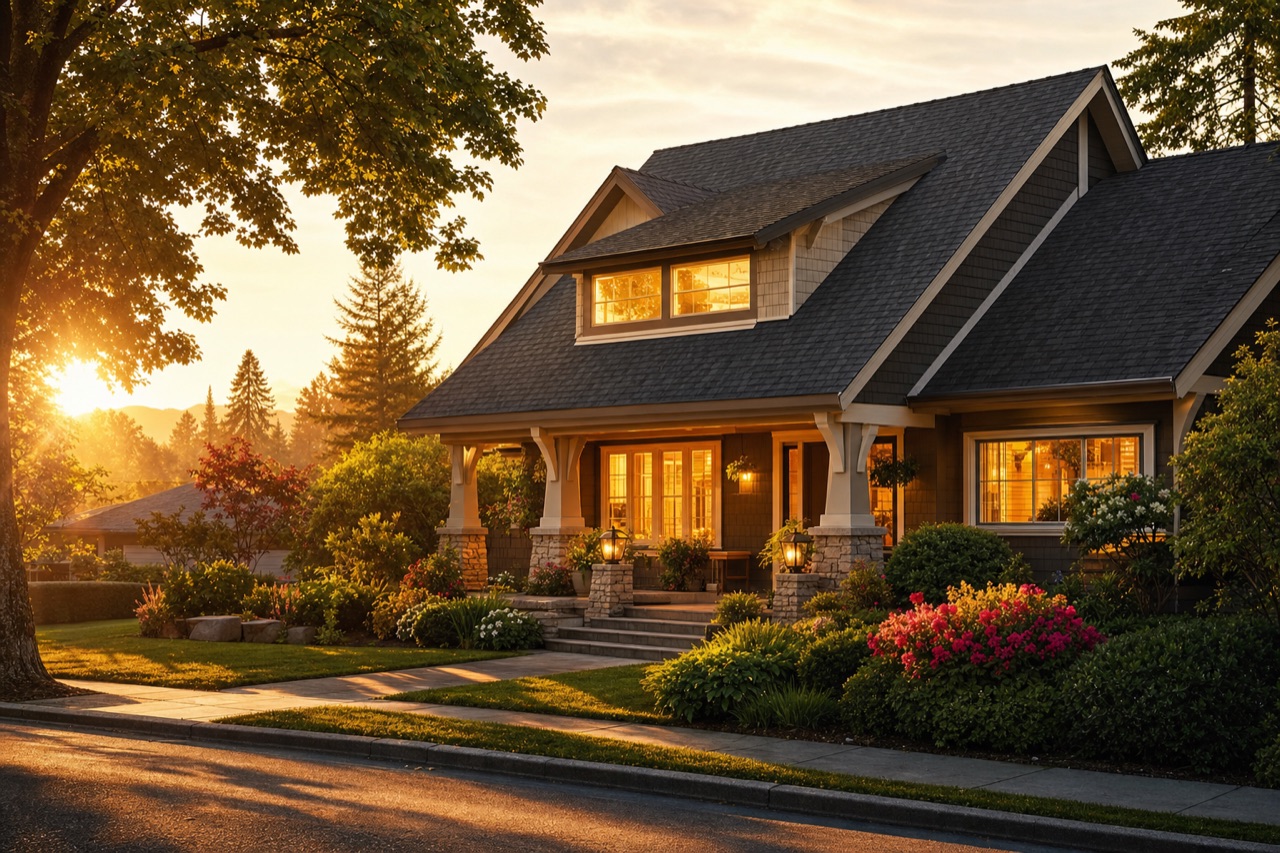
Imagine buying a car you could only see as a one-inch paint swatch. No one would do it — yet that’s exactly how most people choose a roof: from a small sample held up against the sky, trying to imagine 1,500 square feet of it covering their house. Then they live with the result for two to five decades, because unlike paint, you can’t repaint a roof.
The roof is roughly 40% of the visible exterior of a typical home. Get it right and the whole house clicks into place. Get it wrong and no amount of landscaping fixes it. Here’s why the sample chip lies, and how to choose with confidence.
Why a sample chip can’t tell you the truth
Color is not a fixed property of a shingle. It’s a negotiation between the material, its surroundings, and the light — and all three change when you go from a chip to a roof.
Scale changes the color
A small swatch reads more saturated and uniform than the same color across a large, textured plane. Architectural shingles are blends of several granule colors designed to read as one tone from the street; up close on a chip you see the individual flecks, at scale you see the blend. A “warm gray” chip can wash out to a flat, cold gray across an entire roof — or a “weathered brown” can suddenly read far darker than you expected.
Your house changes everything
A roof never appears in isolation. It sits against your fixed, expensive-to-change elements — brick, stone, siding, and trim — and it has to harmonize with their undertones, not just their colors:
- Warm-toned brick or tan siding (red, orange, yellow undertones) pairs with brown, weathered-wood, and warm-charcoal blends. A cool blue-gray roof above warm brick can look like it belongs to a different house.
- Cool grays, whites, and blues pair with slate, charcoal, black, and true grays.
- Stone with mixed tones gives you latitude — pull the roof color from the dominant stone tone.
The rule of thumb pros use: match temperature, then choose contrast. Decide warm or cool first; only then decide how bold to go.
Light is never neutral
The same roof looks like three different roofs over a single day. Harsh midday sun flattens and lightens color; golden-hour light warms it; an overcast sky cools and mutes it. North-facing roofs sit in cooler, more constant light; south-facing roofs get baked and brightened. A shingle chosen under fluorescent showroom light is being judged under conditions it will never actually live in.
Light or dark? It’s not only aesthetic
- Dark roofs (charcoal, black) read modern and high-contrast, hide debris, and can make a home look grounded — but they absorb more heat. In hot climates, that can nudge cooling costs up if the attic isn’t well ventilated.
- Lighter blends (driftwood, slate-gray, weathered tones) reflect more sun, stay cooler, and show less obvious aging — but they show dirt and algae streaking more readily (choose an algae-resistant shingle).
The “forever” test and resale
Two filters save most people from regret:
- Will you still like it in 25 years? Trendy is risky on a surface you can’t cheaply change. The boldest choice you can fully commit to is fine; the trendy choice you’re lukewarm on is not.
- Does it fit the street? Distinctive is good for curb appeal; wildly out of step with the neighborhood can narrow your pool of future buyers. The roof is a major factor in a home’s first-impression value — appraisers and buyers notice a roof that fights the house.
What changes when you can actually see it
When homeowners preview the finished roof on a real photo of their own home — not a chip, not a generic stock house — three things reliably happen:
- Decisions get faster. Seeing beats imagining; the “right” option usually becomes obvious within a few comparisons.
- Regret drops to near zero. You’re choosing the look you’ll actually live with, in context, under your own light.
- Conversations with roofers improve. You arrive knowing the exact material and color you want, which makes quotes more accurate and the whole project smoother.
The most expensive mistake in a roof project isn’t the material — it’s choosing a look you wouldn’t have picked if you’d seen it first, on a surface you can’t undo.
Try it on your own house
This is the entire idea behind ShowMyRoof. Enter your address, pick a material and color, and we render a photorealistic preview of the new roof onto a photo of your home — in under a minute, for free. Compare a warm blend against a cool charcoal against a bold black, all on your house, under your light.
See your new roof now. It’s the cheapest, fastest step in the entire project — and the one that prevents the costliest mistake.